

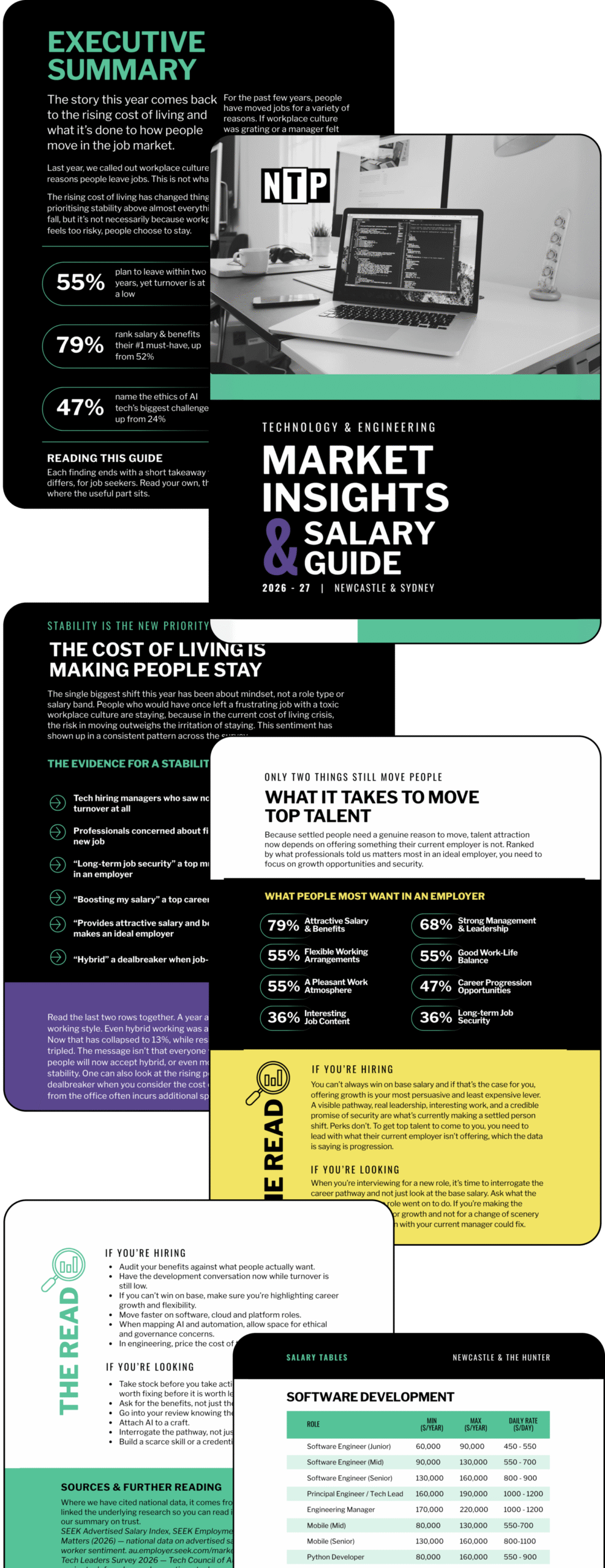
Your Data-Driven Advantage: The NTP Talent Market Insights & Salary Guide
The rising cost of living has rewritten the rules of hiring and retention. People are staying put, and it’s not because workplaces got better. When leaving feels risky, people wait. Beneath the low turnover, most professionals are already planning their next move, they’re just waiting for the ground to feel steadier before they do.
Misread this and you’ll either overpay to solve a problem you don’t actually have, or you’ll risk losing the people you think are settled.
The 2026-27 NTP Talent Market Insights & Salary Guide is built on our 2026 Technology & Engineering Community Survey of hiring managers and professionals across Newcastle, the Hunter and Sydney. Because we survey both sides of the table, we can show you when what employers are planning and what employees want don’t match. And this year, they don’t match in some expensive ways.
We’ve overlaid our findings with national research from SEEK and the Tech Council of Australia, and regional data for the Hunter from the Committee for the Hunter and the University of Newcastle.
Whether you’re a CTO budgeting for a new software team, a leader benchmarking engineering salaries, or a professional weighing up your next move, this guide gives you the hard numbers as well as the context behind them.
Misread this and you’ll either overpay to solve a problem you don’t actually have, or you’ll risk losing the people you think are settled.
The 2026-27 NTP Talent Market Insights & Salary Guide is built on our 2026 Technology & Engineering Community Survey of hiring managers and professionals across Newcastle, the Hunter and Sydney. Because we survey both sides of the table, we can show you when what employers are planning and what employees want don’t match. And this year, they don’t match in some expensive ways.
We’ve overlaid our findings with national research from SEEK and the Tech Council of Australia, and regional data for the Hunter from the Committee for the Hunter and the University of Newcastle.
Whether you’re a CTO budgeting for a new software team, a leader benchmarking engineering salaries, or a professional weighing up your next move, this guide gives you the hard numbers as well as the context behind them.
What the Market Is Telling Us
Every year, the data reveals shifts that dictate how top talent moves. Here are the most impactful trends from our 2026 research and what it means for how you hire, retain, and plan your workforce.

Stability is the new currency
The cost of living has made people stay. Turnover has fallen (43% of hiring managers saw none at all in the past year) but it’s risk-aversion, not loyalty. Beneath the calm is the fact that 55% of professionals are planning to leave their current workplace within the next two years. Right now is the cheapest window you’ll have to fix retention before confidence returns and your top talent all moves at the same time.

Money or growth are the only things moving people
Last year’s top reasons to leave (culture and management) have fallen away and been replaced by direction. 59% of professionals cite lack of professional development, and 57% list greater career progression elsewhere. Yet when managers explain their own turnover, they point to pay and redundancies. If you can’t always win on base salary, growth is your most persuasive and least expensive bargaining tool.

Benefits spend is going to the wrong place
The widest gap in our survey around employee benefits: 62% of employers offer an EAP but only 9% of professionals value it as a drawcard. Meanwhile, the benefits people want most–salary packaging (60%), bonuses, additional super contributions, and private health cover–go under-supplied. In a cost-of-living crisis, people want money in their pocket. If you reallocate benefits spend rather than increasing it, you’ll out-offer competitors who haven’t noticed.

Software engineering is back
The “death of the engineer” was overstated. 60% of hiring managers are planning on hiring software developers and engineers in the next 12 months, up from 32% in 2025. Counterintuitively, demand for AI as a standalone skill fell. We’re seeing more organisations embedding it into their engineering roles rather than building separate AI teams. These are the year’s most contested hires, at exactly the moment candidates are most price-sensitive. Now is the time to move decisively.
Stay in the Loop
The invisible market moves quickly. Sign up to receive our insider updates on hiring trends, salary movements, exclusive community events, and the latest news shaping the tech and engineering sectors across Australia’s east coast.